News and Views

Executive Dysfunction in ADHD

Yes, I’m still on this train. I’m absolutely certain that executive dysfunction is the main issue with ADHD. Since I first wrote about this, I’ve been exploring it all more fully, and I’m having more ideas and so on. So, let’s revisit this concept.

Pinnable image for this post with a picture of a person whose head and shoulders are pixellating and flying away. Or maybe the pixels are coming together to create the person. You decide.

If you do a search for executive dysfunction and ADHD, you’ll get a bunch of stuff about how executive dysfunction is a symptom of ADHD, but not everyone who has executive dysfunction has ADHD. I agree with this: having executive dysfunction doesn’t mean that you have ADHD. However, if you have ADHD you definitely have executive dysfunction.

The problem is that people don’t realize what processes are executive functions, so they don’t see how our executive functions relate to the diagnostic criteria for ADHD. Executive functions are higher-level processes in the brain that let us control our behaviours, our attention, our emotional displays, and so on. The frontal lobe handles this stuff, so if that’s not working the best we’re going to struggle with it. That’s why a lot of people who have a traumatic brain injury struggle with executive functioning, and why so many other brain-specific conditions involve executive functions.

To my mind, ADHD is unique in that every single diagnostic criteria can be tied to at least one executive function.

Inattentive ADHD expects children to show at least six of nine criteria, in multiple settings, for at least six months beginning before the age of 12. Hyperactive/Impulsive ADHD expects at least six of eight criteria, in multiple settings, for at least six months beginning before the age of 12. Combined ADHD expects both six of nine Inattentive criteria and six of eight Hyperactive/Impulsive criteria. For adults, the expectation is five criteria instead of six, but otherwise the same.

There are nine executive functions that I’ve sorted out as of this writing. Eight of these apply to Inattentive ADHD, and four apply to Hyperactive/Impulsive ADHD, while all of them apply to Combined ADHD.

This is why there’s overlap. This is why people who have Inattentive ADHD also have some Hyperactive/Impulsive symptoms, and vice versa.

There are three executive functions that contribute to all three types of ADHD. No matter what type of ADHD you have, you’re probably going to have issues with:

  • Cognitive Flexibility;
  • Goal-Directed Behaviour; and/or
  • Self-Monitoring.

What does this mean? It means that most ADHDers have trouble dealing with sudden changes in their situations or environment (Cognitive Flexibility). It means that most ADHDers struggle with working towards goals, especially if those goals are long-term and progress isn’t something they can see right away (Goal-Directed Behaviour). And it means that most ADHDers are a bit oblivious to how they come across to other people and don’t always realize when their emotions are starting to spike or when they need to eat, use the bathroom, sleep, etc. (Self-Monitoring).

One executive function is specific to Hyperactive/Impulsive ADHD, and that is Inhibitory Control. This means that Hyperactive/Impulsive ADHDers have trouble keeping themselves from doing or saying whatever pops into their head.

The rest of the executive functions are related to Inattentive ADHD. These are:

  • Attentional Control;
  • Cognitive Inhibition;
  • Organizational Skills;
  • Planning; and/or
  • Working Memory.

As a result, Inattentive ADHDers are going to probably struggle with knowing what to focus on and maintaining that attention long-term (Attentional Control). They will likely have trouble tuning out unrelated stimuli and follow a train of thought (Cognitive Inhibition). Their organization is going to be chaotic or non-existent (Organizational Skills). Making and following plans is also very hard (Planning). And their ability to hold information in their minds so they can make decisions and complete tasks is probably impaired (Working Memory).

(I’m not gonna bother explaining how bad it is for us Combined ADHDers. Suffice to say, it sucks.)

I think that if we were to approach ADHD from the view of executive dysfunction, it would suddenly become a lot easier to figure out solutions to the specific problems we experience. Executive functions all interact with each other, so the specific areas we struggle with are impacted based on which executive functions are impaired and just how severely they’re affected.

So consider this the first post in a series about executive dysfunction in ADHD. I’m going to go in-depth into the different executive functions and talk about different ways they interact with each other, and hopefully offer some useful suggestions for how to deal with the resulting problems. I think it’s important to know which executive functions are impaired and how they’re interacting, because that is why systems aren’t one-size-fits-all. The end result looks the same, but the underlying reasons for these problems are different, and that affects the solutions in important ways.

My next post is about Planning and its related executive functions. I have no printable this week, but if you go to the Printables page you’ll find some stuff about executive functioning to get you started.

Parenting When You Have ADHD

I will be up front on this one: I am not an expert on parenting. I have one child, who is nine years old. I’ve done lots of reading and lots of child care over the years, though, so I hope I can share some good, solid tips that will help us all.

Pinnable image branded for Actually ADHD, with a picture of a parent bear and its baby, with the post title in the lower right.

Most parenting material emphasizes the need to be consistent, and as we all know, ADHD and consistency don’t really mix well.

What I think we can do is embrace a way of relating to our children that is respectful of both their needs and ours. We’ll still mess up and still get distracted, but I think this can have a really positive effect on our families and especially on our children and our parenting.

What is Respectful Parenting?

There are lots of different ways to look at respectful parenting, so I’m just going to explain how I think of it.

The first thing to understand is that it isn’t permissive parenting and it isn’t super strict parenting.

In respectful parenting, we treat our children like human beings, because that’s what they are. We keep their actual abilities in mind and help them where needed, we encourage them to grow and to do things for themselves where they can, and we set limits regarding appropriate behaviour based, again, on their actual abilities and developmental stages.

This isn’t exactly easy.

I find it difficult to enforce the limits I set, often because time isn’t real so bedtime tends to get ignored, but also because I don’t necessarily notice when my kid is doing something I’ve said not to do. However, something I’ve noticed is that, while I am something of a soft touch, my kid does talk to me about important things and comes to me for comfort when it’s needed.

Respectfully Parenting Infants & Toddlers

A couple of things to remember about infants.

  • Babies cry because they need something. It is their only way of communicating, and if they are crying you should definitely check on them to see what’s going on. They are not trying to manipulate you, they literally need you.
  • Babies do not need to be entertained by others the entire time they are awake. It is fine to set them up in a safe place and let them do their own thing for a while. Their primary job as infants is to stay alive and to take in their surroundings.
  • Talk to your baby all the time, in your regular speech. Some “baby talk” is fine, and it’s absolutely natural to use a higher pitched voice at times. But talking normally to children is really beneficial to their language development because they learn how sentences work more quickly.
  • Tell your baby what’s going on. When you’re going to do something, tell them what it is first. “Oh, you need a clean diaper. I’m going to change it for you.” Narrate what you’re doing as you do it. This also helps with language development, and your voice is comforting for them.

As your child ages, their needs will change, and their communication will also change. Again, though, they aren’t trying to manipulate you. Very young children simply do not do this.

Once a child is able to crawl, make sure you have a decent-sized area for them to move around. Make it a safe space for the child (e.g., block electrical outlets, keep cords they could use to pull stuff down on their heads out of reach) and put some age-appropriate toys in the area. Block it off with baby gates so they are contained, and let them play by themselves for a while every day.

Play with your child a few times a day as well. Playing with your child will help your relationship; if all of your interactions are caregiving-related (e.g., bathing, changing diapers, feeding) you will not develop as strong a bond. Playing with your child is great for both of you, though, and you really don’t need to play things you dislike or for longer than you can focus at one time.

Respectfully Parenting Preschoolers

Preschoolers are beginning to really be independent. They want to do things for themselves, but they’re not always able to do so. A preschooler’s job is to learn about the world and to learn their own limitations. Your job as parent is to set limits, to teach them, and to keep them safe.

At this point, you do need to start setting and enforcing limits. It’s okay to choose your battles; if you don’t actually care about something, don’t bother setting a limit around it. Consequences should be related to the infraction, and they need to be pretty immediate. So, for example, if your three-year-old keeps throwing cans on the floor at the grocery store, the cans don’t go where he can reach them.

Something to remember about preschoolers is that they have very little impulse control. They simply react in the moment. They may have some huge feelings when you enforce a limit. That’s okay! Be there with them in that. Tell them you’re there when they’re ready for a hug. Then wait. You can’t teach them why you had to do what you did while they’re upset, so you have to wait. That’s all there is to it.

Now, because preschoolers don’t have impulse control, it is our job as the parent to set up their environment to keep them safe and to make it easy for them to observe limits and follow our rules. If your preschooler pulls all the pots out of the kitchen cupboard “even though you told them not to 500 times” that’s not their fault, it’s yours. The first time they did it and you realized you didn’t want them doing that, you needed to secure the cupboard door so they couldn’t get in anymore.

Preschoolers really enjoy doing things themselves though. So finding safe ways for them to help you with a variety of chores around the house is key. Put a chair or stool up to the sink and let them “wash” the dishes with you. Get them a kid-sized broom so they can help sweep up. If they show interest in it, find a way to get them involved.

Keep doing independent play in a safe area, and keep playing with them a few times a day, just for as long as you can focus at once. They will love it and learn so much!

Respectfully Parenting Older Children

As your child ages, they will gain skills and communicative abilities. They will be able to understand more about limits and consequences, and they will slowly be able to control their impulses better and better.

Note that if your child also has ADHD–likely given how genetics work–some of these things will take longer than others. This is where you having ADHD comes in handy. You can apply your personal experiences and knowledge to your child. Even if their symptoms are different from yours, you will be able to offer them understanding. You can also temper your expectations based on the symptoms they show.

The general principles apply across the lifespan.

  1. Your child is a human being and is worthy of being treated with respect.
  2. Communication is the most important part of your relationship with your child.
  3. Limits need to be appropriate to your child’s age, ability, and developmental stage.
  4. Setting and enforcing limits involves setting your child up for success by changing the environment.
  5. Consequences for ignoring limits need to be directly related to the limit itself.
  6. You cannot reason with someone who is dealing with big emotions.
  7. Big emotions are normal and children have more difficulty than adults in controlling how they respond to having those big emotions.
  8. As with adults, having big emotions doesn’t absolve children of any destructive behaviour they engage in, and once they are calm they need to take responsibility for that and make things right if possible.

If there are specific situations you need help with, please share in the comments and I’ll do my best to offer suggestions!

Tips & Tricks: Managing School Assignments

I thought it was about time I wrote a proper, thorough post about how to keep track of your assignments for school. If you’re not in school anymore, this can also be helpful for managing your work projects.

Instagrammable image for this post, including a line drawing of a person sitting among piles of books.

There are a few ways to manage school assignments, and what I’m going to explain here is the system I’ve implemented for my son, who is doing online school for grade three. It’s modified from the (somewhat less organized) system I used when I was in school, and takes a number of tips from the book The Organized Child: An Effective Program to Maximize Your Kid’s Potential—in School and in Life, by Richard Gallagher, Elena G. Spira, & Jennifer L. Rosenblatt, which I’ve discussed here before.

What You Need

No matter what type of school you are in (i.e., grades 1-12, post-secondary) you will need:

  • a calendar to track your due dates
  • a chart to track your current assignments
  • a way to break down your assignments into smaller steps.

Your Calendar

Your calendar can be physical or digital, whatever works best for you. I suggest having a separate calendar for your school assignments, so that the organization and assignments don’t get lost in everything else you do in a day.

You might want to use your phone’s calendar or Google Calendar, or maybe something like Notion or another time management app. I highly recommend assigning each course or class a colour or emoji in a digital calendar, to make it easier to see what different tasks go with.

Or you might want to use a physical planner, one of those little monthly purse calendars, or a wall calendar. Again, I highly recommend assigning each course or class a different colour of pen or highlighter, since even if you aren’t a visual processor the colours will help you ensure that you’re doing what you’re supposed to for each subject.

Using Your Calendar

When you are given an assignment, add the name on the due date and mark it as the subject it’s for.

When you break the assignment down into smaller steps, add each step to the calendar as well, in the same way. This will help you see what you need to do when, which is particularly helpful for long-term assignments and big projects.

If your course has an outline with all of the assignments and readings listed in it, mark all of these things in your calendar as soon as you get the outline. Then when you’re given the details on the assignments, you will be able to break things down and add the steps as usual.

If you are using a digital calendar, set alerts for all of the due dates to remind you of what you’re supposed to do. If your calendar is physical, you will need to check it every morning to make sure you’ve got what’s supposed to be turned in that day, and then again when you start your study session at the end of the day so you can be sure you’re doing what you’re supposed to do that day.

Your Assignment Chart

The Assignment Chart should have columns for:

  • the subject name
  • the assignment name
  • any details about the assignment that are important to remember
  • due date
  • how the assignment is to be turned in (if it’s supposed to be turned in)
  • checking off when the assignment is complete and turned in

You may want to keep one chart for each subject, which will make it somewhat easier to be clear about what’s what.

If you want to make sure you’re clear about what is required, you can show your chart to your instructor and ask if you’re missing any important information.

Alongside the chart, you may want to create a Project Tracker for each assignment that needs to be turned in. On this tracker, you will be able to break the assignment down into steps and list all of the details you need to remember about how it’s supposed to be done, in a way that makes sense for you.

Both of these could be done in an organization app like Notion (Notion is on my mind because I’ve been using it a lot lately), in a spreadsheet, or in a Word document (or Google Doc). You can also show your instructor the Project Tracker to make sure you didn’t miss any steps.

Breaking Projects Down

The most important part of your assignments is making sure you break them down into steps. Seeing the name of the project on your list without a note of what step you need to focus on that day can be super overwhelming. Yes, it can also be really overwhelming to see the whole list of steps, but that’s why you want to put the steps into your calendar: that way you only see the current step.

If you need help figuring out what the steps for a particular assignment is, you can ask your instructor, a school counselor, your friends, or your parents. They may not have difficulty with this aspect of assignments, but if it’s hard for you just be clear with them that you need help and you trust them to help you figure this out. If you don’t think any of these people will be able to help you, you can always ask us here and we will do our best!

You can list the steps on your project page or in your calendar. For my son, I am putting the assignments into the Task Tracker in MS Teams (the platform his school uses) and listing the steps inside of each assignment.

This week’s printable includes a monthly calendar spread, an assignment chart, and a project page. If you would also like to see digital versions of these, let me know your platform and I will see what I can do.

The Partnership

I’m tired of the adversarial language surrounding ADHD. Why am I trying to overcome something that’s part of who I am? Why do I try to trick myself into things? What might happen if I embrace it instead, fully accept the limitations ADHD brings, and start learning how to dance with such an erratic partner?

What is the Dance?

This dance isn’t like the waltz we learned in grade school, where one person leads and the other goes where they’re guided. No, I think of this as more like a pas de deux in ballet, or pairs in figure skating. In both of these, the dancers each have their own part to play and dance independently, then come together for particular moments. If there is no trust, no cooperation, things can go tragically wrong.

In ballet, the pas de deux is usually performed by a male and a female dancer. The male is larger and stronger, and his job is to catch, lift, and support the female as she completes daring acrobatic feats. If the male isn’t on the ball, the female could be seriously injured.

The same expectations apply to pairs figure skating, with the male also being required to throw the female and catch her safely on the way down—stunts that can result in both skaters being hurt badly through a fall and/or skate blades.

With the analogy I’m making here, I don’t think the ADHD is always the male or always the female partner. Rather, I think it’s one of those situations where the support changes depending on the situation. Sometimes the ADHD is the stronger partner, sometimes it’s the one that needs to be caught.

Relaxing into the Dance

As I said above, without trust and cooperation, dancers and skaters risk injury. If there is a mismatch between the partners, there is a risk of injury. And if they are not relaxed, they risk injury. That last is true for soloists, as well.

Being relaxed doesn’t mean flopping around. If you watch world-class dancers and skaters, you will see that they are precise and exacting while also appearing loose and relaxed. This relaxed approach comes from years of practice and study, which leads to confidence.

So in this dance with ADHD, how do we achieve that same level of confidence?

I’m not totally sure yet, but I’m going to try and work it out. I do think that part of it may involve “if… then…” notation (kind of like in computer programming), so you have steps to follow in different situations.

Executive Dysfunction and the Productivity Myth

Part of the problem with current society is the emphasis on “productivity”. In the dance we’re facing with ADHD, executive dysfunction is the name of the game. In our dance (or at least in mine), productivity isn’t the goal. Rather, the goal is to have a good life and to accomplish personal goals. (This is a type of productivity, but I envision it as being far more personal than society does. Society doesn’t care about people doing their own things, just about people doing things that look productive to the world.)

When your dance partner is as inconsistent as ADHD, you need different standards from the rest of the world. You need to remember that you are probably doing what you can at that moment. Other people won’t be able to see it, but you’re the one inside your head. You know what you’re capable of at any given time, and it’s important to honour that.

Here’s the thing, though: honouring our abilities and inabilities doesn’t mean following our whims, letting ADHD wreak havoc in our lives and the lives of those around us, or just generally refusing to take responsibility for the things that don’t work out. That’s not how life works, and it’s not how the dance works.

Rather, we honour ourselves, our ADHD, and the dance by learning what to expect of ourselves in different situations and by learning how to manage unexpected situations. This is going to require some introspection, because we need to know ourselves and our ADHD really well to do both of these things, but I promise it’s worth it.

All of the executive functions can be difficult and exhausting for anyone, not just ADHDers. We’re just more likely to struggle and likely to tire out more quickly.

Attention, Focus, Distraction

The thing most people imagine first when they hear “ADHD” (probably due to the name) is someone who can’t pay attention to anything for any length of time. That’s why people are so confused when we hyperfocus. “You can’t have ADHD, you can focus on X!”

I’ve put Attentional Control, Cognitive Inhibition, and Self-Monitoring under this category because they’re all related, and similar strategies will apply.

The dance here is all about preparation. You need to know what time of day is best for you to do things that require your attention. You need to know how often active breaks will be necessary and whether you should keep snacks on hand so you can eat while working, not to mention which fidget/stim toys are best for which situations. You need to know what kinds of things trigger hyperfocus so you can order your activities appropriately. For example, I know that I hyperfocus on books and on computer stuff, so if I want to do anything else in a day, I should do that before I start reading or go on the computer.

Self-Monitoring is how you know the details you need for everything else. You need to monitor your internal state, your energy levels, your bodily needs (e.g., hunger, bathroom), and so on. Get to know yourself as well as you possibly can, and use that knowledge to your advantage. This is how you master the dance.

Behaviour

The next thing people imagine about ADHD is someone who does all kinds of things at inappropriate times, says things without thinking, and is physically hyperactive. I’ve grouped Cognitive Flexibility, Goal-Directed Behaviour, and Inhibitory Control under this category because these three executive functions are what most affect our behaviour.

This dance requires preparation and contingency plans. You need to know what to do if you make a misstep or something doesn’t go as planned. You need to know what others expect and consider appropriate behaviour in different situations, and you need to know what expectations you’re going to be able to meet based on your energy levels and emotional state. (Hence the need for Self-Monitoring!)

Organization

The third thing that is commonly associated with ADHD is disorganization, including being late for things. This category involves Organizational Skills, Planning, and Working Memory.

I don’t think there is one way of organizing things that is going to work for everyone. It’s important to make sure that you personalize your systems. How do you process information? How do you work best? Figure these things out and be aware that they may change over time.

And so this dance is all about organizing and re-organizing, learning new ways to stay on top of things, and remembering what to do when and where. You need to be prepared with materials and information. You need to have systems in place to help you remember things. You need to have strategies to organize your time and environment in a way that will benefit you.

With all three of these categories, it’s really important to remember that you are doing what you can as you can. Don’t beat yourself up if you make a mistake—they’re to be expected. Mistakes are learning opportunities: analyze them to see where things started to break down, so you can start tweaking them to keep that breakdown from happening again. Yes, it’s a lot of work, but it’s work that is really rewarding because it helps you create the life you want by accommodating your difficulties without completely dumping expectations.

We are Human Beings and We Deserve Respect

I think it’s particularly important to remember that you are a human being first and that ADHD and whatever other conditions you might be dealing with don’t negate that. Rather, they are all part and parcel of being human. And because you are a human being, you deserve to be treated with respect.

There’s a saying, “Respect isn’t given, it’s earned.” And sure, that’s true of one type of respect: the kind given to authoritarians, which isn’t true respect because it often goes one direction. Respect should be given, regardless, and it should be mutual. Yet even if someone is disrespectful, it’s better to respond with respect than to be nasty right back.

When I’ve moderated discussion forums online, my primary rule is that everyone should be respectful of each other. I admit to being imperfect in this regard—emotions get the better of me sometimes, just like everyone else—but that is always my goal. I know it is possible to disagree with someone on a very base level and still treat them with respect.

For me, this is a really basic level value. I believe that all human beings have an intrinsic worth that makes us worthy of being treated with dignity and respect. And so I do my best to live that value, though it can be difficult when I’m not being treated well.

How does this relate to everything I’ve talked about so far?

I think there’s a danger, when we come at our ADHD as an adversary, of becoming disrespectful of ourselves. I’ve seen it. I’ve done it. All of my negative self-talk, which is ever so automatic after a lifetime of it, is disrespectful lies.

“I can’t do anything right.” >> Patently false; anyone can see evidence to the contrary.

“I don’t matter.” >> Untrue. I have family and friends, and I have animals in my life that depend on my care.

“I’m so stupid.” >> Says the woman who did fairly well in school and got a Bachelor’s degree.

The weird part is that the disrespect is always over things like this. Things that aren’t true. If it’s true, I don’t put myself down about it. I’m gaslighting myself, and it’s really disconcerting. But I don’t think it’s an accident that these things are also things that my ADHD impacts. I make mistakes, I struggle, I am a people pleaser and a perfectionist.

In addition to the self-disrespect, we can run into disrespect from others. There’s the casual disrespect from friends and family: “Did you forget to take your meds this morning?” “You can’t possibly have ADHD because you aren’t exactly like me/my friend’s cousin/etc.” And from teachers/professors: “You don’t need extra time on tests.” “I don’t think you need a fidget toy in my class.”

And the kicker: disrespect from medical professionals.

I’m lucky in that I haven’t had to deal with this much in relation to my ADHD. But it’s something a lot of people contend with, and it sucks. My favourite recent one is when a family asked their doctor about ADHD as a possibility for their child, and the doctor said it wasn’t a thing because said child was “too calm”; parents asked about different presentations for girls vs boys, and the doctor said it wasn’t true. Child was confirmed ADHD by a psychologist who knew what they were doing.

I’m not going to get into why I think it happens, because it will probably sound like I’m excusing mistreatment and I’m sure there are studies on it anyway. What matters is that it does happen, and it’s never okay. (I also have ideas regarding the ways in which that doctor was right and wrong at the same time, but that’s for another post.)

You are a human being, and you deserve respect. You matter, simply because you are alive.

I don’t know you, but I know the dance you’re trying to learn—not all of the specifics, because all of our dances are different due to our different life circumstances—and I know it’s hard. I also know that it’s worth the struggle. It’s worth trying to learn how to work with ADHD’s inconsistency. It’s worth working on a particular step even if we perfect it just as we stop needing to use it. It’s worth all of the tears, the muscle strains, and the headaches.

I think the stumbles are part of the dance. I think that mistakes can be beautiful. I think that none of us will ever truly master the dance, and I think that’s okay because what matters in life is that we do our best. I think that embracing ourselves fully, respecting ourselves and our difficulties while taking responsibility for our mistakes, is a really hard thing to do but also the most rewarding thing we can do.

This dance isn’t one and done. It’s a daily slog. Every day we recommit to learning the steps and doing our best to fully respect ourselves. Every day we’re faced with new steps to learn, because every day is different. (At least we’ll never be bored, right?)

I think I may have mixed my metaphors a little too much in this piece, but here it is anyway. I hope my meaning comes across. I hope the linked YouTube videos help to illustrate what I’m talking about. Any questions, please ask. I will try to be more concrete in my replies.

(No printables this time, I don’t know what I would do. Just… watch the videos and leave comments on this post, maybe write your own post and link back here. I’m interested in what you think about all this.)

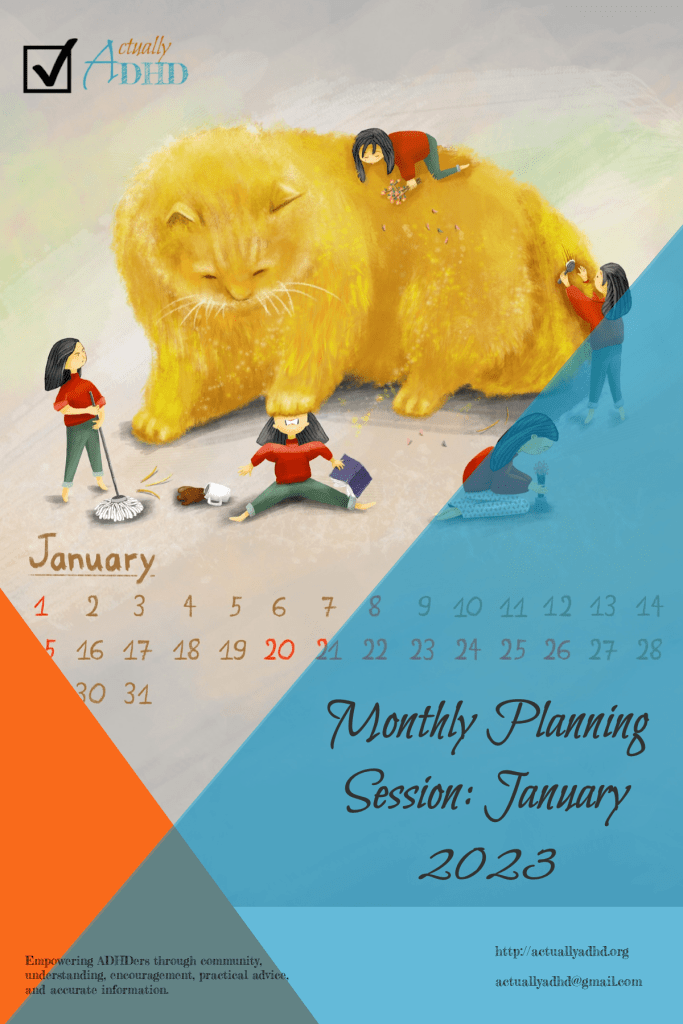
Monthly Planning Session: January 2023

I’m trying something different for 2023, and I think it’ll be a good experiment. At the end of the month, I’m going to do a snapshot like I put in the treatment tracker booklet, and then I’m going to set my goals for the next month based on that snapshot. I’m not going to look really far into the future, I’m just going to think about the coming month.

I think this could be interesting for a bunch of us to do together, so I’ll detail my process in this post and you’ll be able to download a printable at the end of the post that will give you somewhere to keep track of what you’re hoping to accomplish each month.

A pinnable image with a cat, some people performing different chores, and the dates written below.

End of December Snapshot

I have about four major categories that I use for my planner. I split some of them into sub-categories, mainly because I like my small containers.

Now, in the treatment tracking booklet, the symptoms get rated out of 5. For this, I’m not rating each area of my life. Rather, I’m writing down a sentence or two that describes the current state of affairs in each category or sub-category.

I decided not to actually rate each category because I feel like this is an entirely subjective activity, so it’s not likely to provide any truly meaningful data. I’ll be able to see how things change over time without the numerical rating because of my next step.

Once I have my descriptions written, I go back and write down a few things that could improve that area of my life. These are the things that will help me see how I’ve improved (or regressed) in each category.

Overwhelmed!

Writing everything down like this is great, but also overwhelming. There’s so much to do! But I don’t have to do all of it right now. That’s the thing. This is just the jumping-off point. I’m nowhere near finished the planning. But since it is overwhelming, I’ll set it aside and move on to something else.

January’s Important Events & Appointments

While my overwhelming chart is taking a break, I can pull out my monthly calendar and my phone, and start copying events and appointments so they match. I’ll just do January right now, since that is the month I’m worried about.

Back to the Chart

Okay, time to go back to my chart. First I’ll go through the things that I can do to improve my life, noting whether each item is a project or a habit.

Project: A one-time thing, though it may take a long time to complete.

Habit: Anything you need to do regularly, whether daily, weekly, monthly, or yearly.

This helps even more with the overwhelm of the chart, because I only need to choose ONE daily habit to track this month, and I only need to choose one project per category. It’s totally manageable after all; one habit and up to six projects (max) are way easier to think about!

Reminder Time

Now I need to be able to keep these things front & centre. I’m a Visual processor, so I’m going to use pictures (with words alongside) to illustrate my goals. I’ll divide things up on the page by category because I’m a Micro processor too. I’ll keep that page in my planner but have it where I can see it whenever I open it, just because posting it on the wall would be weird for my family.

Visual: Make a poster or fun page in your planner

Hidden: Write it all out in your planner

Micro: Do the above for each life category; don’t be afraid to have sub-categories!

Macro: Put everything together in one place

Following Through

Now I have my plan for January… how do I intend to make sure the plan happens?

That’s where my weekly and daily planning come in.

I think I’ve noted before that I’m good at making plans but struggle with following through on those plans. That has absolutely not changed! My current medication makes it easier, but it’s still not a given. What I’m hoping is that this approach will help me follow through, since everything will be smaller and more immediate. I should be able to have small successes, which will help me continue to work on things.

That’s the idea, at least. We’ll see how it goes.

Weekly Planning

I’m expecting to do my weekly planning on Saturday, hopefully in the evening. I’ll start with the assessment of the previous week, to get that in my head, and then I’ll move to the next week’s schedule.

The first things I’ll put into my week are things that are (or should be) set in stone. That means transferring things from the monthly calendar and then writing in breakfast, lunch, and dinner on each day (because I forget to eat, I have to put these in). Hopefully I’ll be able to figure out an errands day at this point, too. Once I’ve got those foundations, I want to schedule time for me to “Follow my Whims” every day, as well as decompression time. Both of these are vital for me, both because I need to be able to just do whatever for a while and because, as an introvert who is homeschooling an extrovert, I need time to myself every day. These are self-care, and I need to care for myself better. Once that is all in my schedule, I am going to try time blocking again.

Time Blocking?

In case you haven’t heard of it, time blocking is basically like a loose schedule, kind of like what you have when you’re in school. One reason why I think this could work well for me (and for other ADHDers) is that it encourages loose scheduling.

When I’m making a schedule, I’m tempted to get really detailed and break out every single thing I need to do and assign it a time. Then if I get a duration wrong or something unexpected happens, my whole schedule is out the window. Time blocking forces me to be more general, because it’s more like “From 9-10 a.m. I’ll work on house-related tasks.” So what I do isn’t prescribed, it’s up to me to do whatever I can during that time period.

Meal Planning

Don’t forget about meal planning! I have that on my weekly planning page for a reason! I’ll make sure I do that once all the scheduling is done, since then I’ll know what days we need quick meals and what days we might be eating out, etc. Then I can make my grocery list for whichever day I’ll be running errands.

Daily Planning

Nightly I’ll do my assessment of the day and then plan the next day. My Goals and gravy will come from my chosen projects for the month, and of course my habit is from that work as well. I’ll fill out my daily planning page so that it’s easy to see what to do as I move through the schedule from my weekly page.

One thing I’m hoping to start is a monthly YouTube video. That could be a “plan with me” kind of thing, or it could be on a topic. What would you prefer? Let me know!

For now, go forth and use this week’s printable to create your plan for January. Good luck everyone!

Planners: Putting it All Together

Literally none of the links in this post are affiliate links. I am merely providing you with the information you need to check out the resources and materials I have found useful.

The best planner for you is the planner you will use, so let’s really dig into that.

I’m going to guess that you’re reading this because you have never been able to find a planning system that really works quite right for you. You probably use a new system for a couple of weeks, or even a couple of months, but then you stop using it for some reason. The specific reason will probably be different for each person and each time, but basically it stops working because (a) it’s not new anymore so it’s less interesting, and (b) there are things about the system that are incompatible with your processing type and/or particular executive dysfunctions.

How do we figure out what we actually need? Trial and error. Which sucks.

I wish there was some nice, clear list of steps I could share to help you figure it all out, but there really isn’t. This isn’t something that has easy steps. So what I’m going to do instead is talk about the solutions I have found that are working for me, and the changes I’m intending to make come January.

A pinnable image of a road leading off into the distance with the title of the blog post in the bottom right corner.

Processing Type and Executive Functions I Struggle With

As I said earlier, I’m a Micro-Visual processor. I like categories and boxes but I like everything easy to see as well. As for Executive Functions, I have difficulty with almost all of them (benefits of having Combined type ADHD I guess). What I’ve recently realized is that my processing type means that not all of the things that help me will help everyone else, but also my particular issues with executive functioning mean that I’m in a good position to be able to figure out different things that will help others. Weird but true.

When I first found a planning system that worked, I followed the advice in Julie Morgenstern’s Time Management from the Inside Out. I highly recommend her books if you are also a Micro-Visual processor. Her strategies are easy to understand and adjust for different processing types, so they may help you if you’re a different type of processor as well.

Anyway, I’d been trying to use paper planners for years, but I could never find a system that worked consistently. I wound up getting a Palm Z22 (it was 2005), colour-coding and categorizing all of my tasks, and that worked for several years. When the Palm bricked itself, I switched to a Moleskine weekly planner, pocket size. It was just an agenda, and when it ended I moved to the Moleskine daily planner, regular size.

I stuck with the daily planner for several years. I liked having the full day with hours down the side so I could keep track of what I did each day as well as my upcoming appointments. There wasn’t enough room for tracking the things I wanted to track, though, so I started adding stickers and then little booklets I created on the computer. That got ridiculous.

I kept a bullet journal for a year or so, but I had to stop because I got stuck on making it pretty (which I knew was likely to happen but I loved the idea of how customizable it is) and because my hand does not do well with having to write a lot. It cramps up, and I have tendinitis in both arms anyway. Bullet journaling requires a lot of writing, even if you’re keeping it as simple as possible. So I moved to printables… which weren’t quite what I needed.

Again.

What’s Working for Me Now

My current planning system draws from Julie Morgenstern’s book Time Management from the Inside Out, the general ideas inherent to bullet journaling, a system I came up with through trial and error several years ago, BJ Fogg’s Tiny Habits, and the book The Organized Child: An Effective Program to Maximize Your Kid’s Potential—in School and in Life, by Richard Gallagher, Elena G. Spira, & Jennifer L. Rosenblatt. Overall, it’s a good system that works really well for me. There are a few little things that I need to adjust, but that’s about it.

I need to see stuff and I need to do stuff, so writing things down by hand (rather than typing them) helps me remember them better since that’s a physical action. BUT I can’t be writing a bazillion things down every day, because that will kill my hand.

The Books

I use Blueline NotePro notebooks. They use the same hole punch as the Filofax reusable notebooks but take larger sizes of paper.

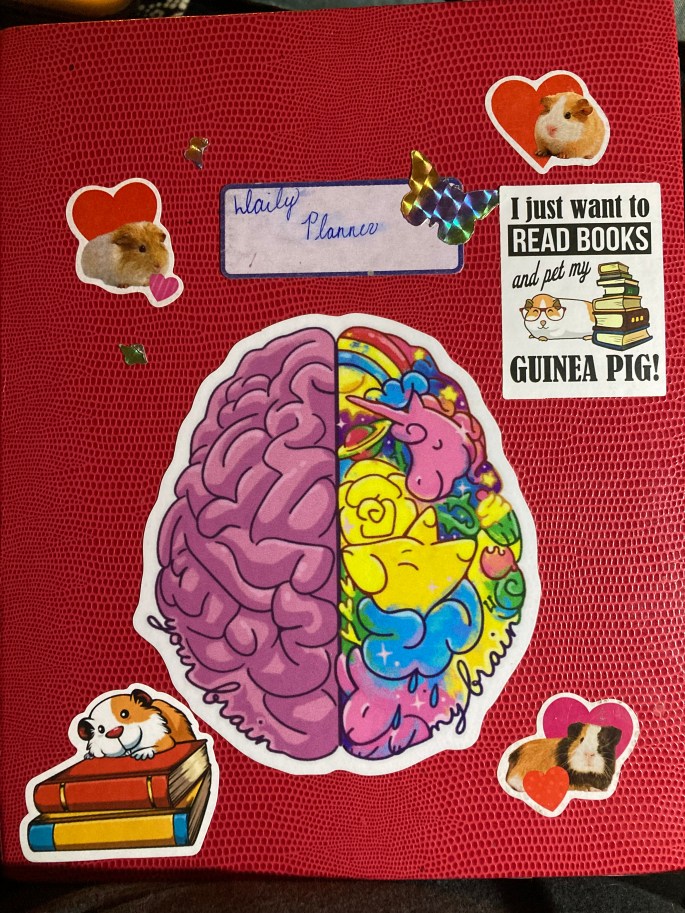
The cover of my Daily Planner notebook, decorated with stickers.

I use a regular MiracleBind NotePro for my monthly/daily pages. The paper size is non-standard—9.25”x7.25”—but I design my pages especially for these books and it’s working well for me so far. One bonus is that my monthly dividers are from a regular “Classic” Happy Planner I found at the thrift store, and while they don’t fit perfectly (a little narrow) they work for what I need them for.

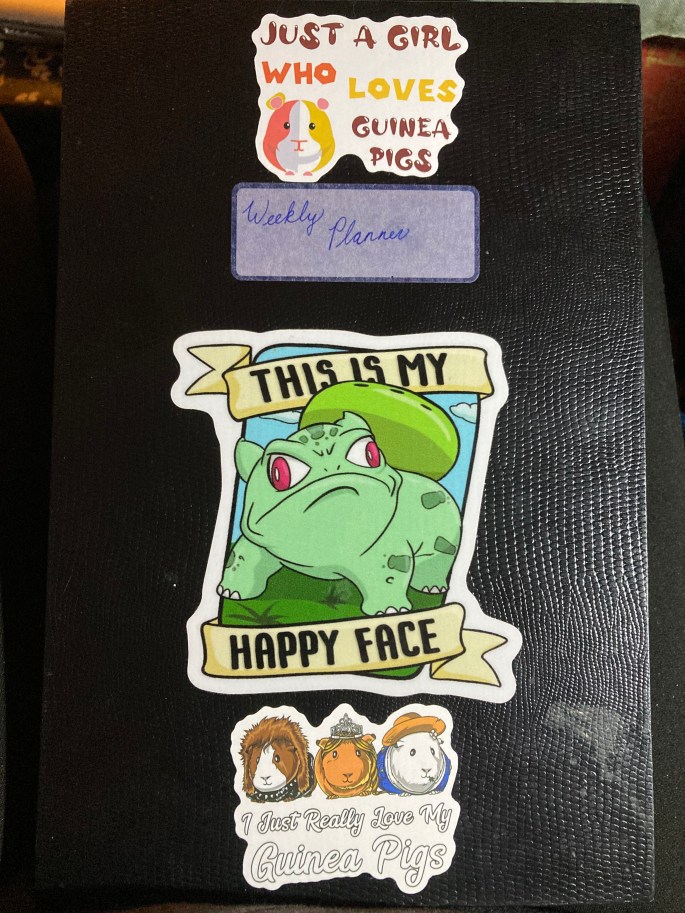
The cover of my Weekly Planner notebook, decorated with stickers.

My weekly planner is not in a MiracleBind, but the binding is still useable, I just have to punch each page twice, with the second set of holes halfway between the first set. It’s a Steno book, meaning that its binding is across the top, and it is 6”x9”. The monthly dividers I use in this are cut from card stock. I’d link to this notebook on Blueline’s site, but I can’t find it. They may have discontinued it.

I have decorated the covers of both of these notebooks with stickers that I really like, which makes them more appealing to use.

The cover of my Project Planning notebook.

My side planners are Filofax refillable notebooks. These take A5 paper, which is a little wider but a little shorter than a half-letter sheet. They have really nice fake leather covers, so I don’t decorate or label them; I just use different colours for different things. I have three. My first one isn’t in use much at all anymore, but I often use it to write ideas in. The other two are used for social media planning and project planning.

The Pages

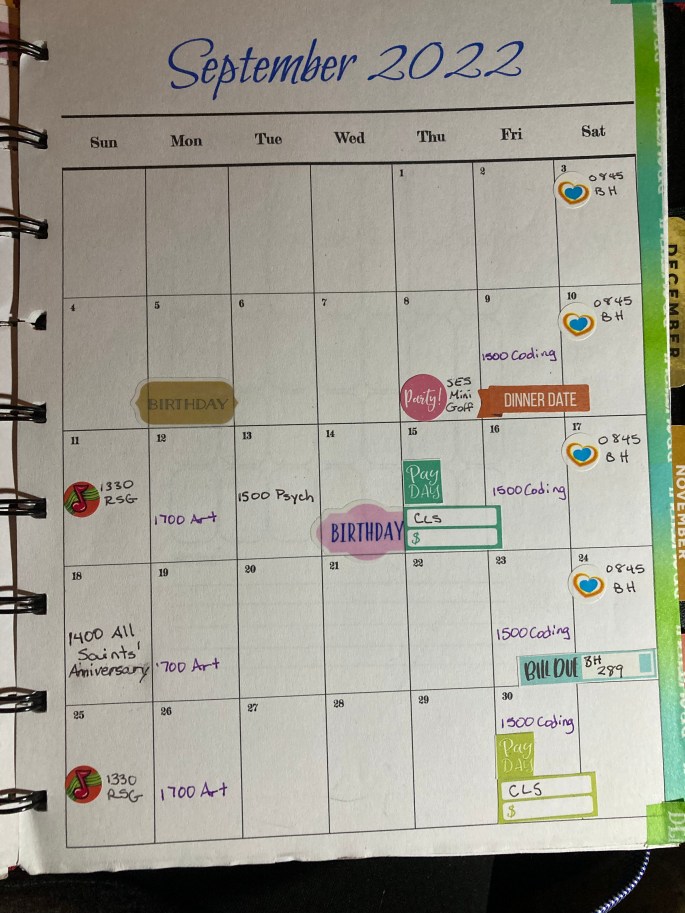
A filled out monthly calendar page.

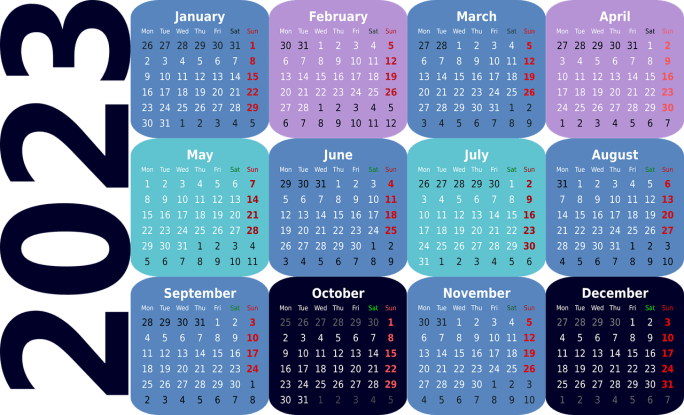
My monthly pages have been in my daily planner this year, but I am going to be moving that to the wall for 2023 since my husband and son need a visual system. I will probably create the pages myself so that I can have them be more functional for us all. That will also let me make changes on the fly, if certain features I try turn out to not be useful for them or for me. I received a 2-year monthly planner in my Christmas stocking this year, so I will probably use that for my personal monthly planning and still create a monthly wall calendar.

A partially filled out weekly planning page.

My weekly pages were a basic schedule grid this year, and it worked okay but I found that I needed a bit more detail. As a result, I’m adding onto the pages and they will be fold-out for 2023. The main part of the page will continue to be the schedule grid with a section at the bottom for weekly priorities, but I’m adding a meal planning grid that will fold out.

The Issues Log.

The back of the weekly schedule is (and will continue to be) an “Issues Log” (as per a video by “How to ADHD”) that I call “Making Life Work”. The columns are for listing what was hard this week, why it was hard, and what I can do differently next week. On the left of this table is a blank spot that will be visible from the front when the weekly page is folded up, and I’ll be using it for Post-Its with tasks I need to do this week listed on them.

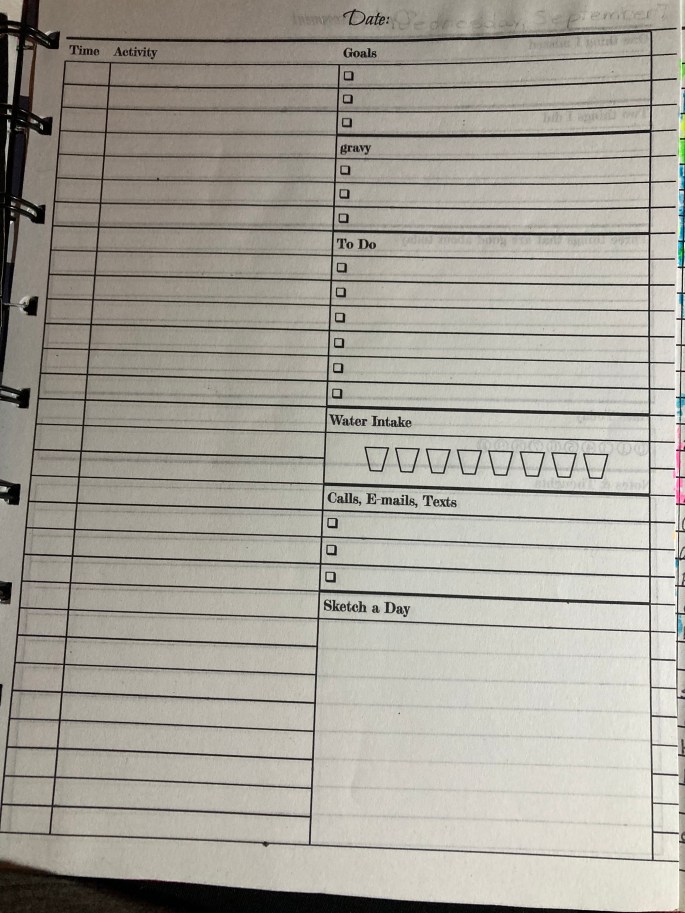
A blank daily page.

My daily pages have a couple of important features. First of all, they are undated. Given my struggles with consistency, it makes more sense to write the date on a page that I’m going to use rather than have a bunch of totally blank dated pages. This also saves paper. Second, I don’t write out all of my daily tasks every single day—I’ll explain how I handle that in a moment.

This past year, the daily pages had a time tracking grid on the left half of the page, where I can write in the time and then note what I’m doing, The right half of the page had Goals and gravy, a method I figured out years ago that helps with Bad Brain Days (I explained this in this post), a place for other To-Do items, a water tracker, a place to list calls, e-mails, and texts that I needed to send, and a box for me to do Sketch a Day. In 2023, I’m modifying the right side of the page to include a daily habit that I want to work on, and I’ve done away with the extra to-dos and water tracker, replacing them with a box for a Post-It (for easy task transfer from day to day) and a box for tracking whatever I feel like tracking that day. The Sketch a Day box is now called “Distraction Depot” and I’ll be using it for Sketch a Day most of the time, but it’s also going to be great for whatever I need to use it for.

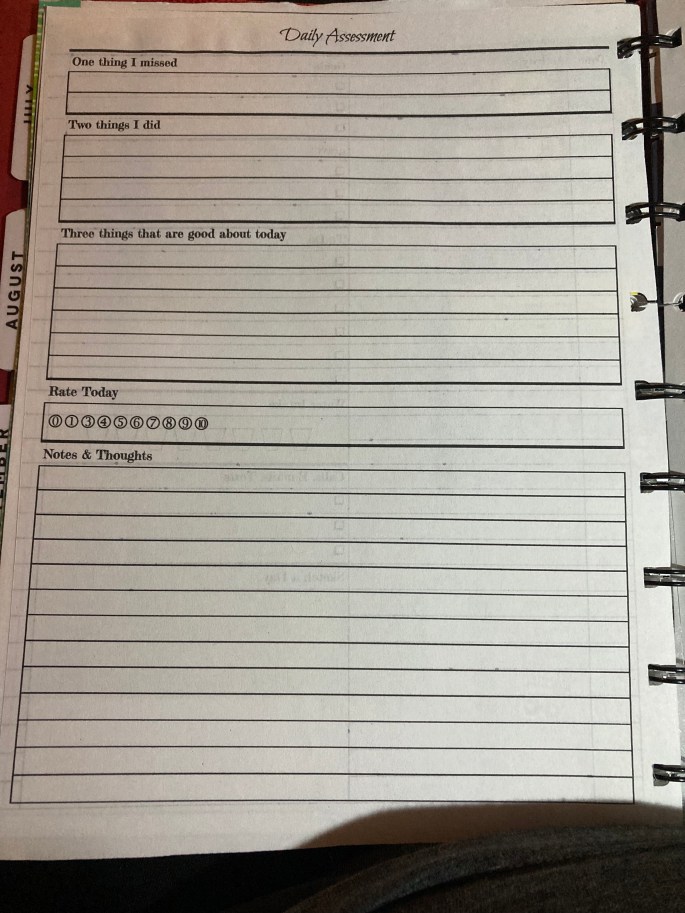
The daily assessment page.

The back of the daily page is an assessment. It asks me to list one thing I missed, two things I did, and three good things about the day. Then I can rate my day out of 10, and the bottom third of the page is for writing notes and thoughts, like a journal entry.

Okay, let’s talk about my daily tasks.

One of the problems I have always had with productivity advice is the whole “choose five things for your list and stick to that”. That doesn’t work when eating, personal hygiene tasks, and laundry need to be on your list! Unfortunately, writing everything out every day is time-consuming and hard on my hand, and it results in a ridiculously long, overwhelming list of stuff to try and get through.

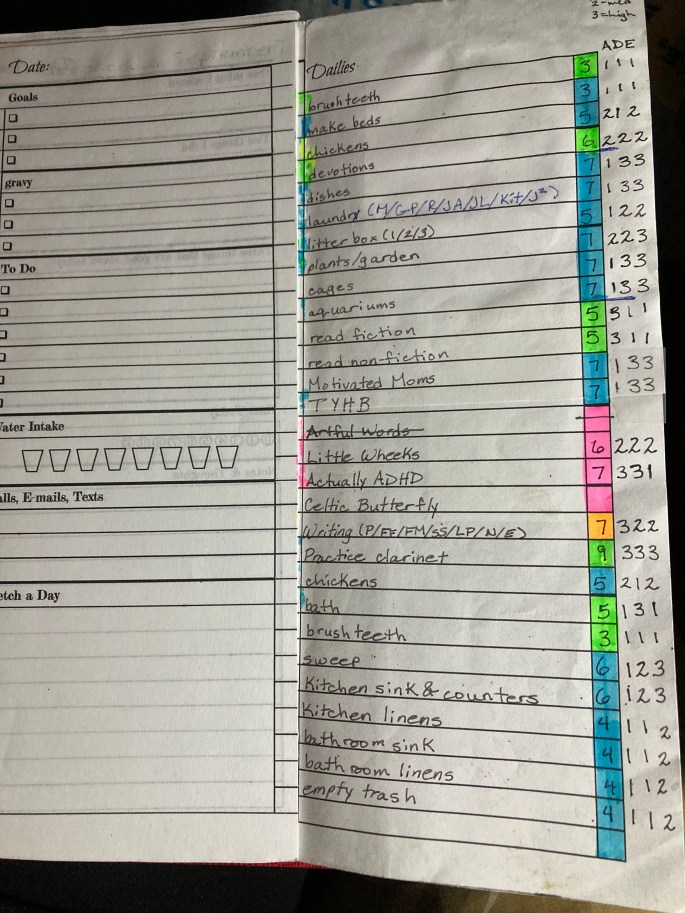
My fold-out dailies list in action!

To deal with this, I have created a fold-out Dailies list and tracker page. It sits at the back of the month and moves over each month. My daily tasks are listed in the right column, and those line up with the little boxes that run down the edge of the daily page. When I complete a task, I colour in the corresponding box on the daily page. I am really proud of this system, not least because the folded over page functions as a bookmark so it’s easy to find the current daily page.

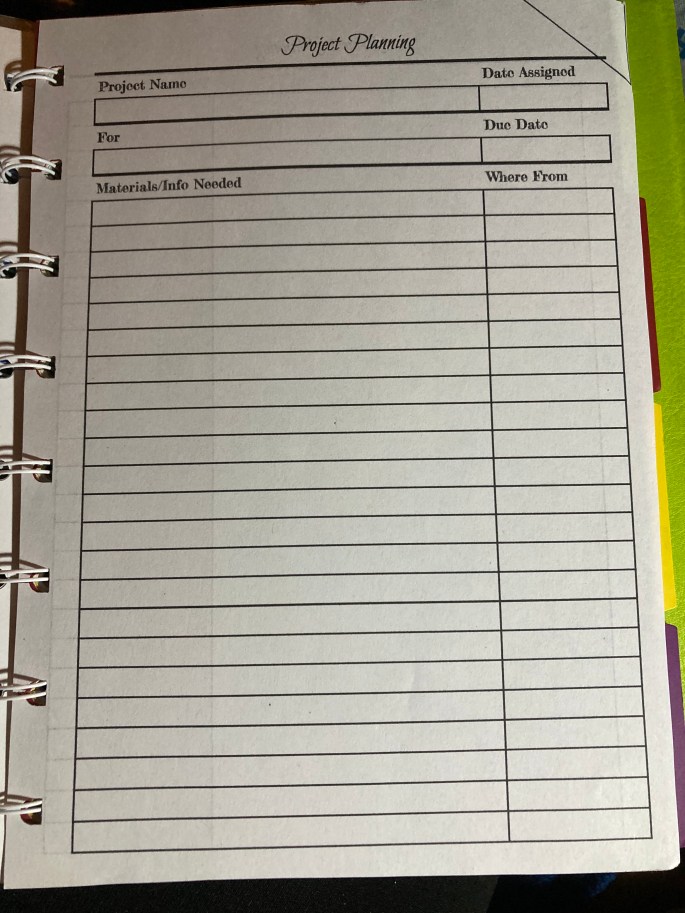
The front of the project page.
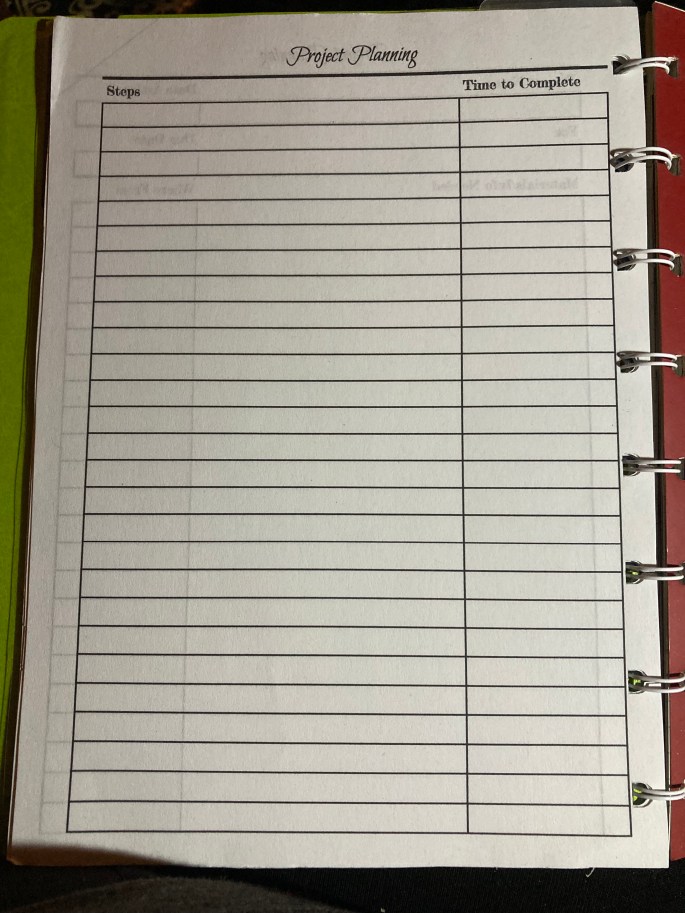
The back of the project page.

My project pages are based on a design I came up with when I was a church secretary. The front of the page is for details like what the project is, when it needs to be done by, and what I’m going to need in order to complete it. The back of the page is where I can figure out all of the steps I need to follow in order to do it. The front of the page also has a place in the top right corner, against the edge of the page, so I can colour it to match the life category it belongs to, which makes it easier to locate quickly. I do fill out a project page for projects that happen regularly, just because then I have all the steps written down and I can check it if I forget something.

My social media pages are just a basic grid. I’ve found that I need to make a few changes to the design of this page for 2023, but basically it numbers the weeks across the top and then lists what type of post and which social media the post should go on down the left. The boxes are where I make notes about specific topics for each day and post. At the top of the page I can fill in the month, how many weeks there are, and what the month’s theme is. I need to add a row to the main grid where I can note what printable or other item I’ll be offering that week, and some rows don’t need to have room for me to write stuff in them because I want to just use a similar type of content every time (e.g., tell funny anecdotes on Thursdays).

The last thing I have so far is a homeschooling planning page, which is a basic grid with the weekdays across the top and a column on the left for the subjects. Then I can write in what I want to cover with my son in the boxes. I haven’t tried using it yet, so I’ll have to report back once I have.

The System

Now, I use my phone calendar for appointments because I can tell it to remind me when it’s time to leave for said appointments. I’ve experimented with a variety of ways to incorporate technology into my analog system, and I do use it where it makes sense for me. For example, I keep my grocery list in my phone.

So here’s what’s supposed to happen.

Appointments go into my phone, then onto the monthly calendar. I also record things like paydays and bill due dates that I haven’t automated on the monthly calendar.

On Sundays, I make sure the monthly calendar is up to date with my phone, and then I transfer the week’s schedule stuff over to my weekly page. I choose my week’s priorities from my current projects. Everything is colour-coded using highlighters and coloured pens (I use Pilot’s Frixion erasable pens).

Every morning (or the night before) I look at my daily page and my weekly page, and I make sure I align my daily Goals and gravy with my weekly priorities, choosing tasks from the applicable project pages.

Why This Suits Me

This system suits my Micro-Visual processing type because it lets me categorize everything while keeping things easy to understand at a glance because of the colour-coding.

Being able to see everything at once by laying out my various books and calendars helps with my Attentional Control.

Having a dedicated notebook for project planning helps me keep things simple, and having a place to write down ideas is great for dealing with issues with Cognitive Inhibition.

The assessments that I’ve included help with Self-Monitoring.

Having that constant Dailies list keeps my repetitive tasks in front of me, which makes it harder to forget them (Working Memory).

Something I would like to incorporate more is adapting my schedule to make Cognitive Flexibility easier and to allow me to indulge my impulses (Inhibitory Control). I also want to schedule my self-care tasks (Self-Monitoring).

Planning, Organizational Skills, and Goal-Directed Behaviour are not things I struggle with as much as I do these other things, but of course having a planning system is useful for all of these areas as well.

What about You?

This system is personalized for me and my needs (and the needs of my family). That means it may not work for you, particularly if you have a different processing type or struggle with different areas of executive functioning. Has this breakdown helped you figure out why past attempts at planning haven’t worked for you? Do you have ideas for what might help you moving forward? Would you like help creating a planning system that will actually meet your needs? Please comment on this post or contact me via the contact form!

This week’s printable is a collection of some of the pages I’ve created for my own use over the years. If you are unable to print things or need to have it all done for you, you will be able purchase a few different types of planners over on Lulu soon (see sidebar link). If the cost is too high, please let me know! I will look into taking preorders and having planners printed locally, then sending them out once they’re all ready. Hopefully that will keep costs down, but I have no idea right now how much that might be.

Christmas has been a bit of time off for me. I’m rather proud of myself for sticking with weekly posts over the past three months!

Next month is January. New month, new year. New goals? Maybe. I keep learning more about how the ADHD brain works and how goal-setting can be simplified for us. I hope you’ll join me next month as I jump into some new ideas!

Planner Features to help with Executive Dysfunction

The best planner for you is the one you will use. All of the “best planner for ADHD” posts out there have testimonials from ADHDers who use this planner or that planner, and they explain why the planner is so great for them. Same with the various planning apps.

The thing is, the features that work great for some ADHDers are awful for others, because we’re all individuals. I’ve tried to simplify everything using four types of processing and nine executive functions, but I guarantee you there are people who don’t fit any neat boxes. Sometimes all you can do is find something that mostly works for you or design your own.

Pinnable image with an illustration of a woman pointing to a date on a huge calendar, with a large clock overlapping the calendar.

Attentional Control

Attentional Control is the ability to control what you pay attention to. It’s basically being able to concentrate. If you struggle with this, you may find it difficult to focus on the planning process and you might get confused if you have to flip pages a lot in order to see what’s going on.

A strategy that can help with this is taking an active break to reset your brain whenever you start losing focus. Walking around (or otherwise getting some kind of cardio activity in) for around 5 minutes can be great for your brain! Another strategy that could help is setting alarms to remind you what you’re supposed to be doing.

A really useful planner feature is being able to have everything visible at once during your planning. This will limit your page flipping and make it easier to see how things fit together. This may require multiple books, but a “traveler’s notebook” style of planner may work well for you, since it will hold 3-4 notebooks all together. You can then have a monthly book, a weekly book, and a daily book, and maybe even another for notes and project planning.

Cognitive Flexibility

Cognitive Flexibility is the ability to change your behaviour and thought processes based on changes in your situation or gaining information. If you struggle with this, you may find yourself getting “stuck” when something doesn’t go the way you expected.

A strategy that can help with this problem is having contingency plans—something we talked about at the beginning of November. I find that having contingency plans lets me reduce my anxiety because I can just remind myself that if the bad thing happens, I already know what I will do so it’s not actually a problem.

Another strategy that is important for this is to make sure that you don’t over-schedule yourself. You don’t want to plan your day down to the second, because if something doesn’t work out or your schedule gets thrown off somehow, you’re going to get stuck and be unable to do anything else for the rest of the day.

The benefit of using a planner if this is one of your challenges is that you can have a section in your planner for contingency plans. You can also use the scheduling aspect to make sure that you allow for mishaps, traffic, and decompression time.

Cognitive Inhibition

Cognitive Inhibition is the ability to tune out unrelated stimuli and stay on task or follow a train of thought. There are a couple of ways difficulty with this can interfere with planning. First, you may get distracted by new ideas. Second, you probably end up making things more complicated than they need to be.

Again, setting reminders can help you remember what you’re supposed to be doing. Another great strategy is to keep a notebook with you so you can write down your ideas and plan out projects. Sometimes just writing an idea down can help you stay on task, since then the need to follow the new!shiny! isn’t as pressing: you aren’t going to forget to pursue it, it’s written down.

A planner can serve as the place you write your ideas down, the place you look when your reminder sounds, and even the place you plan out your projects. It can also help you keep things simple.

Goal-Directed Behaviour

Goal-Directed Behaviour is the ability to control your behaviour so that you’re working towards achieving goals. Problems with this include forgetting your goals, impulsively changing your goals, setting goals that are far too long-term, and impulsively doing things that either interfere with your goals or distract you from your goals.

Strategies that may help with problems in this area include visual timelines, signs to remind you of your goals (one of my uncles kept a sign on the wall in his room when he was growing up that said “WORK!” to keep him motivated to do what he needed to do to achieve his goals), and reminders.

A planner can help keep your goals front and centre. A lot of planners include goal-setting sections and instructions. A planner can also give you a reminder of what you need to do to achieve your goals, and it can help make that timeline visual.

Inhibitory Control

Inhibitory Control is the ability to stop before you act so you can choose the most appropriate way to behave in a given situation. It’s got a lot to do with self-control. The biggest problem you may experience in relation to this is ignoring your to-do list.

A strategy that can help keep you on task is setting reminders for your to-do list tasks.

A planner can help with this if you make a schedule of activities that includes time to follow your whims.

Organizational Skills

Organizational Skills encompass all that sorting, putting things away, etc. The more common problems with this (aside from chaos) include feeling overwhelmed by your tasks and struggling to prioritize tasks.

Strategies that can help with this area include using methods and systems that account for your processing type and learning a few different methods for prioritizing tasks.

A planner can help with this by providing instructions and materials for prioritization. You can also look for planners and planning systems that cater to your particular processing type.

Planning

Planning is the ability to think ahead and to break goals down into smaller steps. When we have trouble with planning, it’s often because we struggle to think far into the future. I like to say that we have trouble seeing the trees for the forest (in other words, we see the big picture but have difficulty understanding the details separately from the whole). And since time isn’t real, we often have trouble knowing how long things will take.

Strategies that can help with planning include keeping calendars visible, timing out tasks so you can better estimate how long something will take, and breaking big projects down into smaller steps.

A planner can help with this because it is, at its most basic level, a calendar. If there is a section where you can work out the steps to your projects, that will also be very useful. And it can provide a good place for you to record information about how long tasks actually take.

Self-Monitoring

Self-Monitoring is the ability to keep track of what you’re doing and how you’re coming across, as well as notice things like hunger, thirst, fatigue, pain, the need to use the bathroom, etc. A common problem here is over-scheduling your day so that you don’t allow time for transitions, bodily functions, etc. It’s also a huge issue with hyperfocus, where you might get so into something that you completely forget that your body has needs. And, of course, there’s the whole emotional regulation thing, where inhibitory control gets involved: we may not realize how we feel about something until we’re already reacting, because self-monitoring is hard.

Useful strategies include setting reminders to engage in self-care, which in this case means taking a shower, brushing your teeth, using the toilet, and going to bed at a sensible hour.

One way a planner can be useful here is in making appointments with yourself to look after your needs. Basically, schedule your self-care and hygiene. You can also use a planner to keep track of things like your mood, your ADHD symptoms, and various things that happen throughout the day.

Working Memory

Working Memory is the ability to hold information in your mind so you can use it to make decisions and complete tasks. Difficulties in this area can be seen in a tendency to forget important appointments, deadlines, or tasks, and/or to forget instructions in the moment.

Strategies that can help with this include writing down instructions as they are given to you, making daily to-do lists, and putting events and deadlines onto your calendar right away.

A planner can be helpful by being the place you write down instructions, the place you keep your to-do lists and your schedule, and a great way to keep your tasks front and centre.

In lieu of a printable, this week I want to encourage you to add the strategies and features that apply to your particular executive dysfunctions to the list from last week. Next week we’re going to look at how I’ve put all of these needs together to create my personal planning system, as well as the changes I’m going to be making for 2023 to accommodate my family members. If you are also responsible for other people’s schedules, you might add their needs to your list as well.

Planners: Your Processing Type

It’s December, and naturally we’re all thinking about the holidays (I hope last month helped you feel more prepared this year!) and about next year. What goals will we pursue? Should we even bother with New Year’s resolutions? Maybe this will be the year we finally get organized!

Well, this month I want to talk about planning and planners. Not so much goal setting and the like, though we may get into that at some point, but the actual processes of planning, choosing a planner, and creating systems that actually work for your particular challenges.

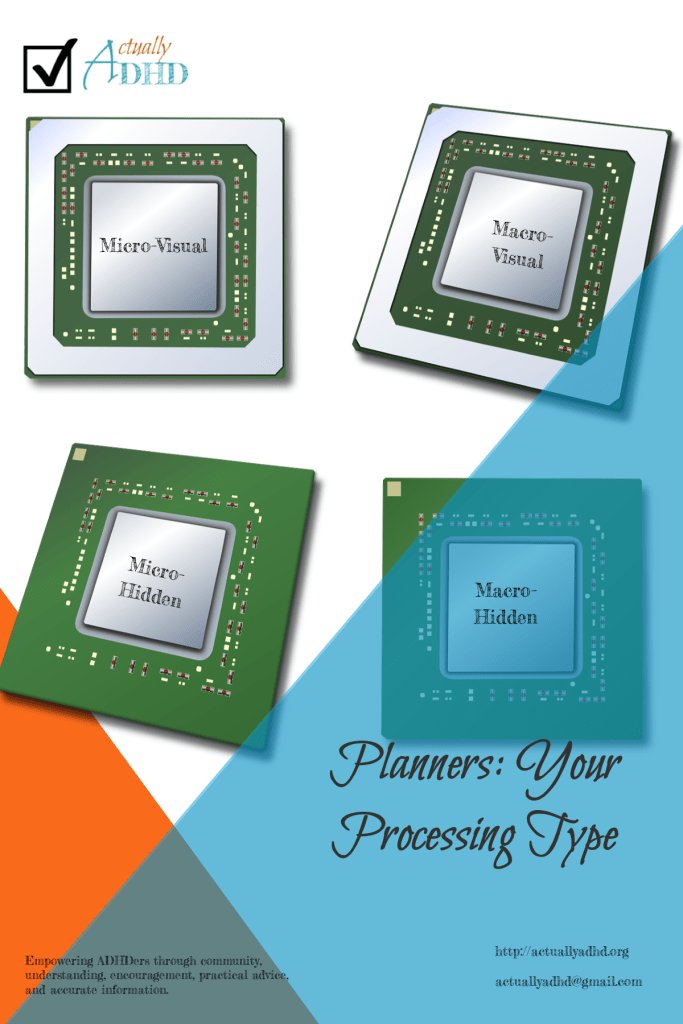
Pinnable image with four computer processor chips, each labelled with one of the four types described in this post.

Information Processing

The question of how your brain actually processes information can be described using a matrix:

 MacroMicro
Visual (also Audio)Everything Everywhere All At OnceColour-Coding
HiddenEverything in boxesBoxes within boxes

The planners you can buy tend to be for Micro-Hidden processors. They’re little books that you write in and carry with you, and everything is categorized and orderly, I don’t think it’s an accident that this is also the type of processor that most organizational systems are designed for. Somehow this Micro-Hidden style has become the expected “normal”, and I really don’t think it’s shocking that ADHDers tend to struggle to meet that expectation.

Most of us default to Macro-Visual, but if you think about the most functional part of your home or the type of planning you are actually good at, you’ll find which style is really “you”.

For example, I’m very much a Micro-Visual processor. I need auditory reminders, I like colour-coding my planner and my filing system, and even in the messiest parts of my home there are little pockets of organization where I have specific things in specific places.

You can also be a combination of types, just like with everything else. So as we go through strategies that may help with your executive dysfunction and planning-related issues, don’t worry too much about whether a given suggestion is meant for a specific type. More often than not, I’ll be describing the strategies as being good for either Macro or Micro processors, or as being good for either Visual or Hidden processors, rather than breaking it down into one of the four.

This idea isn’t mine. It’s from Clutterbug, a professional organizing company here in Canada. Cas (the owner) has done a show called “Hot Mess House” and she has a YouTube channel. She has ADHD, and her system for getting people’s homes organized is based on this concept. She calls each type of processor a different type of bug; I just distilled things into the base descriptors. Macro-Visual processors are “Butterflies”; Micro-Visual processors are “Bees”; Macro-Hidden processors are “Ladybugs”; and Micro-Hidden processors are “Crickets”. I highly recommend her web site and her quiz; doing the quiz is an easy way for you to figure out which type of processor you are!

The Best Planner for ADHD?

The axiom “the best planner for you is the planner you will use” is very true. I don’t think there’s one planner out there that will suit every single ADHDer, mostly because of the whole information processing thing. Couple that with our individual executive dysfunctions, and you have a lot of different planner needs. As a result, I think the most important thing is to identify the features that will help you the most and that suit your processing style, and look for a planning system that meets your needs in terms of both information processing and executive functioning. This system may end up being entirely digital, it may be entirely physical (written), or it may be a bit of both. What matters is that it works for you.

In general, though, a planning system needs to have the following features to make it truly useful:

  1. A calendar so you can keep track of the date, deadlines, schedules, appointments, etc.
  2. A way to keep track of your tasks, ideas, etc.

Everything else is dependent on your specific needs.

My Planner Needs

I’ve used a lot of different systems over the year, and now I make my own pages because I can’t find what I need in-store or even online.

As a Micro-Visual processor, I like to have things categorized and sorted, but I need everything in front of me at once. My husband and my child are both Macro-Visual processors, though my husband may be more of a Hidden processor in some ways and more of a Micro processor in other ways. But this means that a highly visual family calendar is most beneficial, and that keeping schedules and tasks visual for both of them—not to mention hard to miss—is essential.

You may have different needs, depending on which type of processor you are. This week’s printable is designed to help you assess your previous planning attempts, so you can start to really get a feel for what helps you and what doesn’t. Next week we’ll look at features that may help with the different executive functions. My hope is that by the end of December this year, you will better understand how you process information and what kinds of systems and strategies are most likely to help you with your specific executive dysfunctions.

Holiday Disruption & ADHD: Planned Presents

Okay, so gifts aren’t really all that disruptive, but it can be challenging to figure out what to give people while staying within budget. So let’s look at how to decide what to give and how to keep from breaking the bank.

Pinnable image with a Christmas tree that has a bunch of wrapped presents underneath it.

What to Give

The first thing you need to know is who you’re giving gifts to. And by that, I don’t just mean their names. You need to know what they like to do, what their interests are, etc. Who are they?

Once you know who you’re giving gifts to, you need to start noticing your options when you’re out and about. I like to take pictures of specific items with the price visible, so I can look at my ideas when I’m not in the store. It’s also worth talking to the people you’ll be giving gifts to. Ask them what kinds of things they would like to receive, what kinds of things they like to do (so you can give an experience rather than a thing), etc. Maybe they have a wishlist at their favourite store (or on Amazon). If you’re looking at baby gifts or wedding gifts, maybe they have a registry somewhere or a colour scheme they’d like people to observe.

Think about your skills next. You may be able to make really special, personalized gifts for your friends and family. For example, I relearned how to knit and learned to crochet in 2009, and that Christmas I made everyone in my family a toque (“beanie”; knitted winter cap) using their favourite colours. In 2005 when my middle brother was ordained a priest (in the Anglican Church of Canada), I made him a red preaching stole with hand-embroidered symbols (my own design), and it wound up being hand-stitched as well (and about half of that was done by my oldest brother while I was driving us to the service).

I actually don’t enjoy dealing with Christmas and birthdays even though I love giving gifts. That sounds weird, I’m sure, but it makes loads of sense! Why? Because what I really want to do is just give incidental gifts. If I see something that I know a friend or family member would love, then I want to just get it and give it to them right away. Just ask a few of my long-distance friends about the little things I’ve sent to them out of the blue.

How to Budget

I’m planning to do a whole series of posts on finances next year, so I’m only going to talk about how to keep costs down (or at least reasonable) when buying gifts.

The first thing to do is decide how much you can afford to spend overall. Obviously it’s best to set a bit aside each month for different types of gifts, but since we’re really focusing on Christmas (winter holidays) right now, and we’re looking at about three weeks until you need to have the presents ready to go, we’re going to talk about last-minute gifts this week.

When you know your total budget, you can decide how much to spend per person. I like to use multiples of $5 per person because it’s easier to math, and I usually expect to spend more per adult than per child. If money is particularly tight, you could decide to give family gifts instead of individual gifts. For example, I could decide to give my youngest brother and his family a board game like Candyland (his kids are the right age for that) and my middle brother and his family (they have four kids, and the oldest is a teenager while the youngest is early elementary) might enjoy a family activity like a cooperative board game, a set of plain dishes and foodsafe paints, or a family pass to the nearest science centre.

If you’re going to make gifts, you need to think about how long it will take to make each thing, as well as how much the materials will cost. Yarn can be very expensive, but you can cut those costs if you have a large stash built up to choose from. Same with fabric for sewn items. Paint can also cost a fair bit, but one tube will do more than one item. One of the art YouTubers I like to watch, Mira Byler, painted 30 wooden tree ornaments in a recent video. She already has loads of different types of paint, so the immediate cost for something like that would be the cost of the ornaments and the ribbon for people to use to hang them up. If you’re doing something like that, you can easily personalize them. And all it’ll cost you is a bit of time and a few materials you can probably buy in bulk.

When to Wrap

My family is notorious for our “family wrapping paper” being the bag from the store the gift was bought at. Not at Christmas (usually), but birthday gifts are usually just in the store bag. I don’t recommend this method of wrapping gifts unless you and your loved ones are like us and have a warped sense of humour.

We are also notorious for waiting to wrap gifts until we’re at my parents’. Why, you ask? Because my dad saves the wrapping paper (we are not allowed to rip wrapping paper off our gifts) and it is kept in a couple of bins, along with labels and gift bags and so on. So we bring gifts to my parents’ and then we find a time when we can be alone with the gifts and the wrapping paper stash, and we wrap and label the presents.

If you don’t have a stash of wrapping paper and/or you’re not travelling for the holidays this year, I recommend using gift bags and tissue paper instead of wrapping paper. You can usually find great gift bags at the dollar store!

So when should you wrap the gifts? Honestly, it may be best to wrap them as you bring them home. Just make sure you label them and have a good place to keep them where you won’t forget about them but also won’t have to deal with other people trying to guess at their contents.

I don’t have a printable for you this week, but if you would like one to guide you through this process, let me know in the comments on this post and I will see what I can do.

Next month we’re going to talk about planning and planners, particularly as they relate to and are affected by executive dysfunction.

Holiday Disruption & ADHD: Tumultuous Travel

Of all the things that happen during the holidays, travel is one of the worst for disrupting our lives. ADHDers are notorious for struggles with packing and timeliness, not to mention how many of us just get lost on our way somewhere!

Let’s talk about how to know what to bring, how to be on time for flights (or the bus), and how to make sure we get where we want to go.

Pinnable image with a photo of an over-stuffed suitcase.

Packing for a Trip

There are a few questions you need to know the answers to before you can pack for a trip:

  1. How many days will you be gone?
  2. Is there anything special you need to bring (e.g., a special outfit, gifts)?
  3. Will you be able to do laundry while you’re away?
  4. What is the weather supposed to be like while you’re there?

The answers to these questions will help inform how many clothes you need to bring and what else you need to pack. Let’s break down the categories.

Clothes

If you can do laundry while you’re away, you can bring fewer clothes than if you can’t do laundry. But let’s look at this from the most practical angle.

The best way to keep your luggage down but have plenty of options for what to wear is to pack separates. You’ll probably want the following:

  • 2-3 bottoms
  • 4-6 tops that all go with all of your bottoms
  • 1 pair of underwear per day of your trip
  • 1 pair of socks per day of your trip
  • pyjamas
  • 1 dressy outfit for any more formal events (e.g., party, church service) you will attend–this doesn’t need to be separates
  • any other items you need (e.g., bras)
  • slippers if you wear them
  • shoes for everyday that go with your separates
  • shoes for your dressy outfit
  • proper outerwear for the weather (e.g., winter coat, rain jacket, windbreaker)
  • wallet/purse

Remember, unless an item of clothing is dirty or smelly, you can wear it again. If you don’t want to wear the exact same outfit more than one day, that’s why you have more tops than bottoms. Mix and match and you’re golden.

Toiletries

How many times have you forgotten to bring a toothbrush on a trip? I have a great way to avoid that.

I have a toiletries bag that I keep packed.

Yes, it means I have two of some things, but it means that when I’m going somewhere all I need to do is grab the bag, toss in the stuff I only have one of, and I’m good.

Here’s what I keep in my toiletries bag:

  • toothbrush
  • travel-size toothpaste
  • travel-size shampoo
  • travel-size conditioner
  • dental floss
  • travel-size body wash
  • razor
  • hair elastics

Other things you can keep in your toiletries bag:

  • travel-size shaving cream
  • brush and/or comb
  • travel-size hair products (e.g., hair spray, mousse)
  • deodorant

When you’re packing to go on a trip, add any jewelry or makeup you need to have with you. Unless you travel a lot, I don’t recommend keeping makeup in your toiletries bag, since it will probably expire before you get proper use out of it.

Other Stuff

Other things you might want to bring on a trip include homework if you’re in school, books to read, hobbies that you enjoy (and don’t take up a lot of space), gifts for family and/or friends you’ll see, and electronics–including chargers–like a laptop or tablet.

The best way to keep this under control is to choose a bag to carry things in and keep it contained to that one bag. This will make it easier to keep track of what you’ve brought, because less stuff and fewer bags to keep track of means you’ll do better at remembering to take it home with you. If you’re doing gifts, you might want a second bag for gifts, which can then house any gifts you receive on the way home.

Number of bags

If you’re flying, you need to keep everything to a minimum, so you’ll want to keep the gifts small and fit them in your suitcase with your clothes and toiletries, and then use your carry-on bag for your activities and electronics.

If your mode of transportation doesn’t charge for extra luggage (e.g., you’re driving), you can use a box for gifts and a bag for activities, and have your suitcase as well.

Keeping Track

When you’re at your destination, you’ll need to keep track of your things so you don’t forget to bring it all home with you. I recommend having a checklist for everything that you brought so you can consult it while packing to leave, but there are a few more tricks you can use.

  1. Keep your clothes in the suitcase. If you need to hang something up, keep your suitcase in the same area as the closet. To separate dirty clothes from clean, I use that pocket that goes across the back of my suitcase to hold dirty underwear and socks, but you could use any other way of separating your clothes within the suitcase (e.g., other pockets in the suitcase, a space-saving packing bag).
  2. Keep your toiletries bag in the bathroom and the items from it in the bag or nearby (anything you use in the shower will need to dry off before you return it to the toiletries bag).
  3. When you finish using something, put it back in the bag you’ll be transporting it in. This keeps it all together and you’ll be less likely to forget it.

Being on time

It’s so easy for us to be late for things like flights. Here are my best tips for being on time when traveling.

  1. Know when you need to be at your destination or the airport (or other transportation hub).
  2. Know how long it will take to travel to your destination or transportation hub (wherever you’re going from your house). This will tell you when you need to leave.
  3. If you’re taking a plane or other mode of transportation, consider calling ahead for a taxi or shuttle to take you to the transportation hub. You tell the taxi service when you need to be at the airport (or whatever) and they send the cab for the right time based on traffic and so on.
  4. Pack the day before you’re leaving so all you have to do is load the car.

Finding Places

A map is a great thing. If you have trouble reading a map, GPS is an excellent substitution. Take note of things like landmarks to help you remember where to turn and stuff. Getting specific directions can also be really helpful, but make sure they’re written down so you don’t forget them.

This week’s printable is meant to help you make your packing checklist and figure out when to leave. I hope it helps you have a great holiday!